


Page 28 - Steel Tech India eMagazine Volume April 2022
P. 28
VOL. 16 • NO. 3 • April 2022

                                                                    one with sinter plant dust (50 % sinter AcP dust and
                                                                    50 % sinter GcP dust) and another with steel melting
                                                                    shop sludge. Stoichiometric amount of coke dust is
                                                                    used as a reductant. Initially the fine samples (less
                                                                    than 104 micron) are homogeneously mixed with
                                                                    coke dust & adhesives and agglomerated to form
                                                                    cylindrical briquette of diameter 25 mm with the help
                                                                    of a pressure mould. Bentonite (5 wt %), molasses (4
                                                                    wt %)and moisture (2 wt %) are chosen as adhesives
                                                                    and the applied briquetting pressure is 50 kg/cm2.
                                                                    the prepared briquette is allowed to dry at room
                                                                    temperature for 24 hours. Drop test and abrasion test
                                                                    is successfully performed to check the durability under
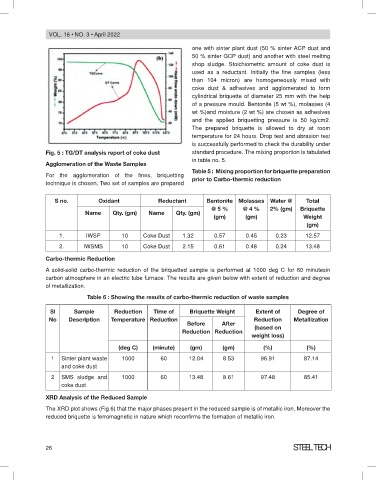
                 Fig. 5 : TG/DT analysis report of coke dust        standard procedure. the mixing proportion is tabulated
                                                                    in table no. 5.
                 Agglomeration of the Waste Samples
                                                                    Table 5 :  Mixing proportion for briquette preparation
                 For  the  agglomeration  of  the  fines,  briquetting   prior to Carbo-thermic reduction
                 technique is chosen. two set of samples are prepared


                    S no.           Oxidant             Reductant        Bentonite  Molasses  Water @       Total
                                                                           @ 5 %      @ 4 %     2% (gm)   Briquette
                               Name      Qty. (gm)   Name      Qty. (gm)
                                                                            (gm)       (gm)                Weight
                                                                                                             (gm)

                      1.       IWSP         10     coke Dust     1.32       0.57       0.45       0.23      12.57
                      2.      IWSMS         10     coke Dust     2.15       0.61       0.48       0.24      13.48

                 Carbo-thermic Reduction
                 A solid-solid carbo-thermic reduction of the briquetted sample is performed at 1000 deg  c for 60 minutesin
                 carbon atmosphere in an electric tube furnace. the results are given below with extent of reduction and degree
                 of metallization.
                                Table 6 : Showing the results of carbo-thermic reduction of waste samples

                   Sl      Sample        Reduction     Time of      Briquette Weight       Extent of     Degree of
                  No     Description    Temperature Reduction                             Reduction     Metallization
                                                                   Before      After
                                                                 Reduction Reduction      (based on
                                                                                         weight loss)
                                           (deg C)     (minute)     (gm)       (gm)          (%)             (%)

                   1   Sinter plant waste   1000         60        12.04       8.53         96.91           87.14
                       and coke dust

                   2   SMS sludge and       1000         60        13.48       8.61         97.48           85.41
                       coke dust
                 XRD Analysis of the Reduced Sample

                 the XRD plot shows (Fig.6) that the major phases present in the reduced sample is of metallic iron. Moreover the
                 reduced briquette is ferromagnetic in nature which reconfirms the formation of metallic iron.


                 26                                                                                     Steel tech

