


Page 46 - Steel Tech India eMagazine Volume April 2022
P. 46
VOL. 16 • NO. 3 • April 2022

                       Technology, Product Development and Application


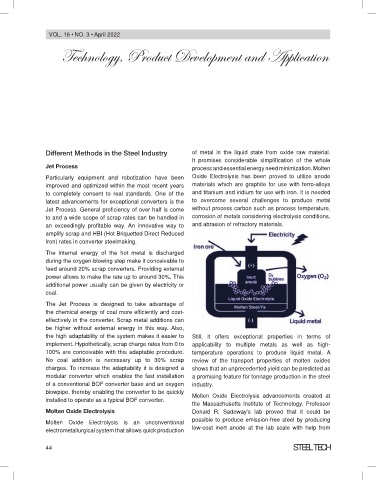
                 Different Methods in the Steel Industry            of metal in the liquid state from oxide raw material.
                                                                    It promises considerable simplification of the whole
                 Jet Process                                        process and essential energy need minimization. Molten
                 Particularly  equipment  and  robotization  have  been   Oxide  Electrolysis  has  been  proved  to  utilize  anode
                 improved and optimized within the most recent years   materials which are graphite for use with ferro-alloys
                 to completely consent to real standards. One of the   and titanium and iridium for use with iron. It is needed
                 latest advancements for exceptional converters is the   to overcome several challenges to produce metal
                 Jet Process. General proficiency of over half is come   without process carbon such as process temperature,
                 to and a wide scope of scrap rates can be handled in   corrosion of metals considering electrolysis conditions,
                 an exceedingly profitable way. An innovative way to   and abrasion of refractory materials.
                 amplify scrap and hBI (hot Briquetted Direct Reduced
                 Iron) rates in converter steelmaking.

                 the internal energy of the hot metal is discharged
                 during the oxygen-blowing step make it conceivable to
                 feed around 20% scrap converters. Providing external
                 power allows to make the rate up to around 30%. this
                 additional power usually can be given by electricity or
                 coal.

                 the Jet Process is designed to take advantage of
                 the chemical energy of coal more efficiently and cost-
                 effectively in the converter. Scrap metal additions can
                 be higher without external energy in this way. Also,
                 the high adaptability of the system makes it easier to   Still, it offers exceptional properties in terms of
                 implement. hypothetically, scrap charge rates from 0 to   applicability  to multiple metals as well as high-
                 100% are conceivable with this adaptable procedure.   temperature operations to produce liquid metal. A
                 No  coal  addition  is  necessary  up  to  30%  scrap   review  of  the  transport  properties  of  molten  oxides
                 charges. to increase the adaptability it is designed a   shows that an unprecedented yield can be predicted as
                 modular  converter which enables the fast installation   a promising feature for tonnage production in the steel
                 of a conventional BOF converter base and an oxygen   industry.
                 blowpipe, thereby enabling the converter to be quickly   Molten Oxide  electrolysis advancements created at
                 installed to operate as a typical BOF converter.
                                                                    the  Massachusetts  Institute  of  technology.  Professor
                 Molten Oxide Electrolysis                          Donald R. Sadoway’s lab proved that it could be
                                                                    possible to produce emission-free steel by producing
                 Molten Oxide  electrolysis is an unconventional
                 electrometallurgical system that allows quick production   low-cost inert anode at the lab scale with help from

                 44                                                                                     Steel tech

